REVIEW · NORTH ISLAND
15,000ft Tandem Skydive in Tauranga – Bay of Plenty
Book on Viator →Operated by Skydive Tauranga · Bookable on Viator
One jump, and Tauranga looks different. This tandem sky jump from high altitude pairs serious speed with some of the best aerial views you can get in the Bay of Plenty. You’ll head up from the Tauranga Airport area, then drop from around 12,000 feet for a fast freefall and a smooth canopy ride.
Two things I really like: the instructor-led safety (they handle the parachute opening and you’re briefed well before takeoff), and the flight time that’s actually part of the experience—about 20 to 25 minutes of scenery before you ever leave the plane. One possible drawback: it’s weather dependent, so if conditions aren’t right, your date may change.
If you want a high-impact thrill day without hours of rushing around town, this is a tight, well-paced outing. It runs about 1 hour 30 minutes total, and it caps at a small group size (maximum 2 travelers), which keeps things calm.
In This Review
- Quick hits on this 15,000ft–style tandem jump from Tauranga
- 15,000ft in Tauranga: why this jump feels so worthwhile
- Price and value: what $332.01 gets you (and what costs extra)
- Where you start: Tauranga Airport area and the 2 Dakota Way meeting point
- Arrival timing: why showing up 30 minutes early matters
- The scenic flight: 20–25 minutes of Bay of Plenty views from above
- The jump itself: freefall for up to 40 seconds at 200 kph
- Parachute timing at 5,000ft—and the 5-minute canopy ride
- What you’ll spot from the air: Tauranga, Mt. Maunganui, and White Island
- Small group size: max 2 travelers, so you’re not fighting the crowd
- Who this suits best (and who should consider the limits)
- Weather rules: what can change your date and why that’s normal here
- Photo and video: plan your keepsake decision before you’re in the air
- Booking timing: why you may want to reserve sooner than later
- Should you book this Tauranga 15,000ft–style tandem jump?
Quick hits on this 15,000ft–style tandem jump from Tauranga
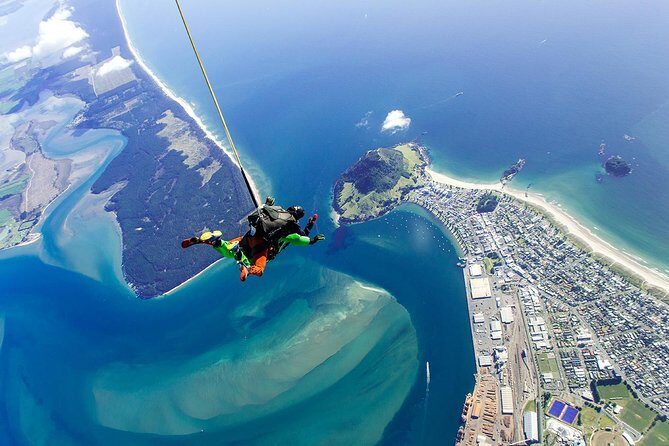
- Altitude plus variety: freefall for up to 40 seconds, then a 5-minute canopy ride
- Real speeds, real timing: over 200 kph in freefall, with the parachute opened at 5,000ft
- Huge Bay of Plenty visibility: Mt. Maunganui, golden beaches, White Island, and more
- Focused instruction: you’re supported throughout, with the parachute managed by your instructor
- Small-group feel: activity maximum is 2 travelers
- Photo option not included: video and photos are available on the day if you want them
15,000ft in Tauranga: why this jump feels so worthwhile
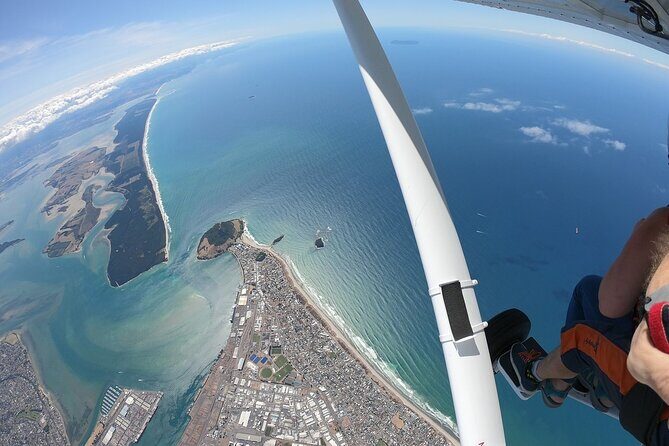
There’s a reason people plan their New Zealand “wow” moment around a tandem jump. From up high, the Bay of Plenty turns into a clear map: coastline, bays, and volcanic terrain all at once. This one is built around that payoff—takeoff leads into a long scenic climb, then you get speed and control options at altitude.
What makes it especially appealing is that it’s not only about the jump itself. You’ll spend about 20–25 minutes in the air admiring the view, which means you get time to spot landmarks and calm your nerves before freefall starts. Then you get the adrenaline hit—freefall reaching over 200 kph—followed by a slower canopy glide where you can take part more if you want.
The big value point for me is how the experience is structured for first-timers. The instructor is in charge of the parachute system, and they pull the parachute at 5,000ft, which helps you avoid the mental load of equipment timing. That matters if you’re excited but also a little anxious.
You can also read our reviews of more tours and experiences in North Island.

Price and value: what $332.01 gets you (and what costs extra)
At $332.01 per person (with GST included), this sits in the practical mid-range for a tandem high-altitude jump in New Zealand. You’re paying for a trained instructor, aircraft time, and the safety system that makes tandem sky jumping possible.
Here’s the part that helps you budget realistically: video and photos are not included. They’re available on the day, so if you want proof of the moment, you’ll likely spend extra. That means the base price is the “get up and jump” cost, while the visual keepsake is an add-on decision you make at the airport.
Another value angle: the experience time is tight—around 1 hour 30 minutes. You’re not signing up for a half-day tour with lots of waiting. And the group size being capped at 2 travelers makes it feel more personal than the big, busy operations some people avoid.
Where you start: Tauranga Airport area and the 2 Dakota Way meeting point
You’ll meet at 2 Dakota Way, Mount Maunganui 3116. The activity ends back at the same meeting point, so you’re not trying to figure out transport after you land.
The jump itself departs from a central, easy-to-find location near Tauranga Airport. Since those details are both important, I’d plan your day so you can get to the meeting point without stress. If you’re coming from elsewhere on the North Island, arriving with a buffer makes a big difference when you’re about to climb into an aircraft.
Also, it’s worth noting that this is described as being near public transportation. That doesn’t mean you’ll have a front-door stop, but it’s a good sign if you’d rather not rely entirely on your own car.
Arrival timing: why showing up 30 minutes early matters

This is one of those experiences where early arrival isn’t just “nice”—it’s how the day stays smooth.
Plan to arrive at Skydive Tauranga 30 minutes before your chosen start time. That window is used for instructor briefing, which you’ll feel good about later when you’re strapped in and ready. A briefing also helps you understand what’s expected during the scenic flight and exactly how the freefall and canopy ride work.
I’d treat the “30 minutes early” as part of the experience, not an extra hassle. The goal is simple: less confusion in the lead-up, more enjoyment once you’re airborne.
The scenic flight: 20–25 minutes of Bay of Plenty views from above
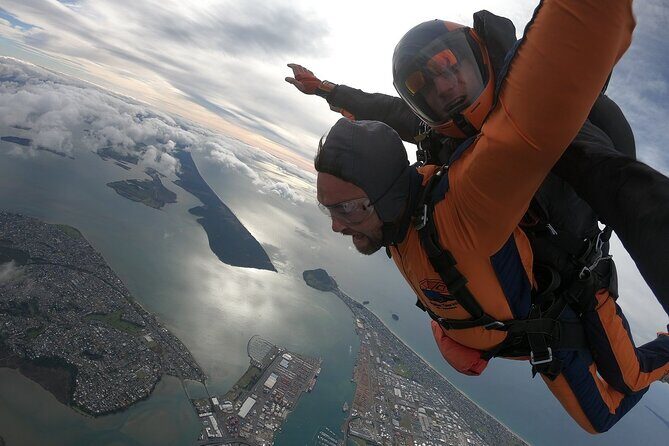
Before the jump, you’ll get a 20–25 minute scenic flight. This is one of my favorite parts on any air-based activity because it turns anxiety into focus: you can watch the coast grow, spot landmarks, and get used to the motion of flight.
From higher up, you may see:
- Mt. Maunganui and Tauranga’s coastline
- golden beaches stretching farther than you’d expect
- White Island (when visibility allows)
- Mount Ruapehu and the Rotorua Lakes region
- the Coromandel area
- and even Mount Taranaki on a good day
This isn’t just sightseeing for sightseeing’s sake. When you can actually identify where you are, the whole experience feels more real. Instead of “I’m falling,” it becomes “I’m dropping over a coastline I recognize.” That mental anchor can make a huge difference for first-timers.

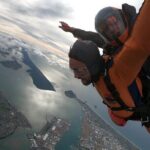
The jump itself: freefall for up to 40 seconds at 200 kph
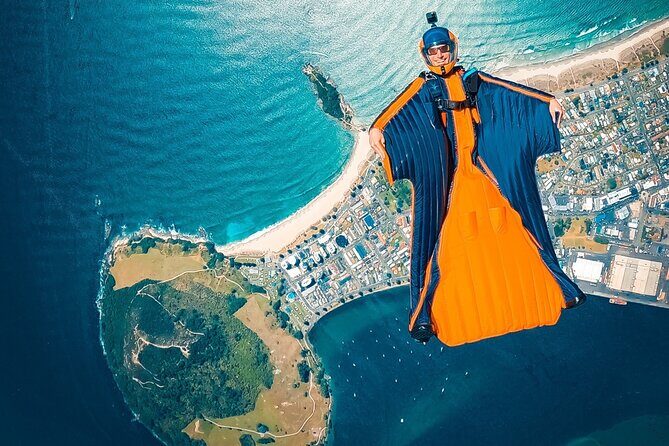
Now the main event. You’ll reach freefall speeds of up to 125 miles per hour (200 kilometers per hour). In practical terms, that’s fast enough to feel like your body is being pressed into your harness while the world rushes by.
The freefall lasts up to 40 seconds. That sounds short on paper, but at that speed, it feels like a full-on adrenaline moment. If you’re the type who worries you’ll freeze or second-guess mid-air, the instructor handles the key steps so your job is mostly to react calmly and follow instructions.
Parachute timing at 5,000ft—and the 5-minute canopy ride
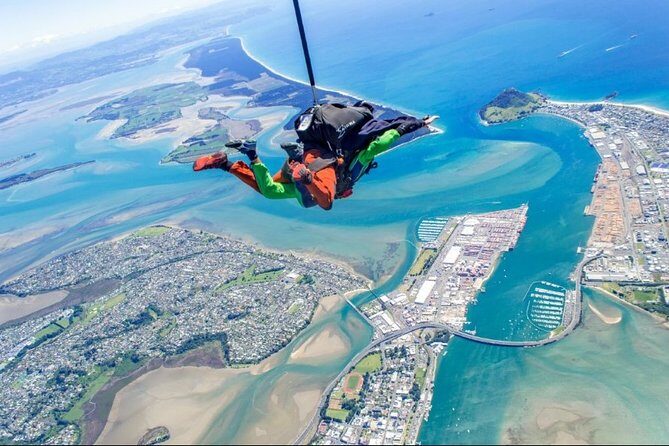
At 5,000ft, your instructor pulls the parachute. This transition is important. It’s the moment the experience shifts from aggressive speed into a calmer glide, and you’ll feel the change right away.
After that, you’ll enjoy about a 5-minute canopy ride down. There’s an extra option here: if you’re feeling brave, your instructor may allow you to pass control for that canopy segment. You get that little taste of participation without losing the safety structure.
This part is also where you’ll often get the best sense of the view again. Freefall is loud, fast, and intense. The canopy is slower and gives you time to look around—coastline, beaches, and the terrain spreading beneath you.
What you’ll spot from the air: Tauranga, Mt. Maunganui, and White Island
One of the strongest reasons to book this particular jump is the viewing potential. The Bay of Plenty area is visually dramatic from above, and this itinerary is set up to help you see it.
You’ll likely focus on:
- Mt. Maunganui and the shape of the surrounding beaches
- Tauranga’s urban edge meeting natural terrain
- the volcanic features that make New Zealand’s North Island look different from other places
- and White Island, if weather and visibility cooperate
On a good day, the bigger-name distant peaks come into play, including Mt. Taranaki, plus Mount Ruapehu and Rotorua Lakes. “On a good day” is the key phrase here. If visibility is limited, you may not see all those far-off points, but you should still get strong coastal views.
Small group size: max 2 travelers, so you’re not fighting the crowd
The activity has a maximum of 2 travelers. That tends to change the mood. You’re less likely to feel like you’re part of a factory line, and it usually means more time for instruction.
I like that combination—big thrill, but not a chaotic crowd. If you prefer controlled, low-stress experiences, this small cap is a real plus.
Who this suits best (and who should consider the limits)
This experience states that most travelers can participate, but it also has clear boundaries.
You’ll want to consider the 110 kg weight limit. If you’re near the limit, it’s smart to double-check before you book so you don’t waste time planning around a date that ends with an issue at check-in.
It’s also a good match if you:
- want a first high-altitude jump with an instructor managing the parachute
- care about scenery as much as speed
- prefer a shorter, focused day (about 1.5 hours total)
If you don’t like being on a fixed schedule, plan your day around the selected start time. This is not a “drop in when you feel like it” kind of experience. Times run from early morning until evening, but you still choose a window ahead of time.
Weather rules: what can change your date and why that’s normal here
This activity requires good weather. That’s not a warning sign—it’s a basic reality for flying and tandem jumps.
If poor weather cancels the experience, you’ll be offered a different date or a full refund. That flexibility is important because coastal and regional weather can shift quickly, especially in areas where you get sea breezes and changing visibility.
My advice: treat your booking like a plan with a weather backup. If your New Zealand trip is tightly packed with only one Bay of Plenty day, you might want to build in at least some flexibility.
Photo and video: plan your keepsake decision before you’re in the air
Video and photos are not included, but they’re available on the day. That means you can decide once you see what’s offered at the operation.
If you’re a “I want proof” person, it’s worth setting aside extra cash for that option ahead of time. If you’d rather keep costs down, you can skip it and rely on your memory of the view.
Either way, you’re still getting the full experience: the scenic flight, freefall, parachute opening, and canopy ride.
Booking timing: why you may want to reserve sooner than later
This one is, on average, booked about 21 days in advance. That doesn’t mean you can’t find a date closer in, but it does suggest popular time slots go first.
If you’re aiming for a specific time of day—morning light versus later visibility—booking earlier helps.
Also, the voucher is a mobile ticket, and you’ll receive confirmation at the time of booking. That’s helpful if you like having everything ready on your phone.
Should you book this Tauranga 15,000ft–style tandem jump?
Book it if you want a safe, instructor-led thrill with a strong payoff in views. This is a tight, high-impact experience: scenic flight first, then freefall for up to 40 seconds at around 200 kph, then a canopy ride where you can even take part if the instructor allows it. The high marks for friendliness and support matter here because you’ll want calm guidance when your adrenaline is high.
Skip or think twice if weather timing is a problem for your itinerary. Since the jump depends on good conditions, a single fixed-day plan can leave you scrambling. Also keep the 110 kg limit in mind early.
If you’re going to the Bay of Plenty and you want one unforgettable, distinctly New Zealand moment, this tandem sky jump out of the Tauranga area is a strong choice.